
APRIL 2026 LUNCHEON MEETING
Dr. Peter Flaig
presents:
The significance of the Wilcox-Carrizo transition with emphasis on the Paleocene-Eocene Thermal Maxima (PETM) in core and outcrop, Texas
11:30 AM Wednesday, April 15, 2026
at Willow Brook Country Club
3205 W Erwin St.
Tyler, TX 75702
Cost: $25 if you RSVP
$30 at the door if you do NOT reserve
Abstract
Deposits of the Wilcox Group, including the Carrizo, serve as significant aquifers and oil/gas reservoirs across Texas. Wilcox-Carrizo deposits are inherently heterogeneous from the smallest to largest scale. Significantly, the Sabinetown Formation of the Wilcox Group found in outcrops in Bastrop, TX has been shown to contain evidence for the Paleocene-Eocene Thermal Maxima (PETM). Because the PETM is a worldwide hyperthermal event of relatively short geological duration (~ 200k years), deposits contain unique biostratigraphic and geochemical characteristics including a negative δC13org isotope excursion and acme of the dinoflagellate cyst Apectodinium homomorphum. These unique characteristics allow us to use the PETM as a “timeline” to correlate stratigraphy across the region. This talk discusses the Middle Wilcox to Carrizo transition in three locations across Texas, with a focus on the PETM interval.
Evidence for the PETM in Wilcox Group outcrops near Bastrop includes palynomorph marker species consistent with Gulf of Mexico (GOM) PETM taxa coupled with overall highly negative δ13Corg values. The dinocyst Apectodinium homomorphum is intermittently abundant, including a superabundance interpreted as a PETM acme. The Sabinetown Formation comprises heterolithic, bioturbated tidal deposits interpreted as tidal delta front and tidal flat deposits. Sediment bypass to deeper-water upper Wilcox deposystems occurred during an estimated 3-5 my hiatus at a sub-Carrizo unconformity that separates PETM deposits of the Sabinetown from the overlying Carrizo. The marine Carrizo comprises sand-rich, transgressive estuarine or tidal-delta deposits with abundant Ophiomorpha.
Several core from the Slocum Oil Field in Anderson County are showcased that contain the Carrizo and overlying Reklaw, including the flooding surface at the base of the Claiborne Group. Deposits are from fluvio-deltaic to offshore environments, with the biostratigraphy indicating an Eocene (Ypresian) age.
I will also discuss reconnaissance-level sedimentology and biostratigraphy of undifferentiated Wilcox Group deposits exposed along a ~17-mile shoreline transect of the Toledo Bend Reservoir in Sabine County, Texas. Preliminary biostratigraphic results indicate that the oldest deposits are Paleocene (late Selandian). It is highly likely that the Paleocene-Eocene Thermal Maximum (PETM) is preserved in the outcrop belt based on the age of the lowermost and uppermost sediments analyzed along with evidence for a weak Apectodinium acme (PETM indicator taxa). Evidence for the PETM can be used as a timeline to link the Toledo Bend deposits to PETM-age to post PETM sediments exposed in outcrops near Bastrop, TX and to deepwater Gulf of Mexico core.
Biography
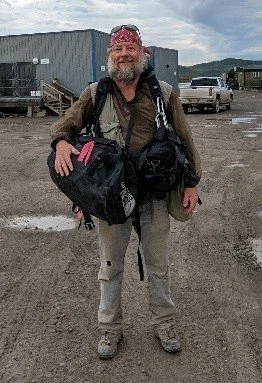
Peter P. Flaig is a Research Associate Professor at the Bureau of Economic Geology, UT-Austin. His Master’s and Postdoctoral work took him to the Central Transantarctic Mountains of Antarctica where he examined sedimentation across the Permian-Triassic boundary. Peter collaborated with paleontologists during his PhD research on the North Slope of Alaska identifying ancient depositional systems and ecosystems of the dinosaur-bearing Prince Creek Formation. He joined the Bureau of Economic Geology in 2009 for a postdoctoral fellowship, and then spent 7 years as lead scientist on fluvial, deltaic, and shallow marine research at the Quantitative Clastics Laboratory Industrial Associates Consortium. Peter has worked for the State of Texas Advanced Resource Recovery program for the past 9 years, specifically on the Strawn, Wilcox, and Woodbine.
Peter’s research focuses on deposits of siliciclastic and mixed carbonate-clastic systems, typically integrating sedimentology, ichnology, paleopedology, palynology, geochemistry, high-resolution image capture and analysis, reservoir characterization, and petroleum geology. He has worked extensively on deposits of the Cretaceous Western Interior Seaway from Texas through the southwestern US (UT, CO, and WY including the Book Cliffs), Canada, and Alaska. Peter has continuing investigations on strata deposited across the Paleocene-Eocene Thermal Maximum in Texas, Colorado, and Wyoming, Pennsylvanian reservoirs on the Eastern Shelf of the Permian Basin, the Cretaceous Woodbine Fm, and the Brookian Megasequence on the North Slope of Alaska.
Peter’s contact information is--email: peter.flaig@beg.utexas.edu, telephone: 512-471-9622, Address: Bureau of Economic Geology, The University of Texas at Austin, University Station, Box X, Austin, TX, 78713-8924.
Affiliations & Accreditation
PhD University of Alaska-Fairbanks – Geology/Sedimentology
MS University of Wisconsin-Milwaukee – Geology/Sedimentology
BS University of Wisconsin-Milwaukee – Geology